


Blog
AI Security Agents vs. Traditional SIEM Tools: What Businesses Need to Know
- 2026-11-02
- threat detection services
Summary: AI security agents are changing how organizations investigate threats, prioritize alerts, and respond to cyber incidents. Traditional SIEM platforms provide centralized security visibility by collecting and correlating data from multiple sources. Understanding how these technologies differ helps businesses strengthen threat detection services and improve security operations. Combining intelligent automation with managed compliance services also supports better risk management, incident documentation, and accountability.
Cybersecurity teams face growing alert volumes, complex attack paths, and limited time to investigate suspicious activity. AI security agents introduce a more autonomous approach by analyzing security data, gathering context, and assisting with investigation or response. Traditional SIEM tools remain essential for centralized monitoring and event correlation. Businesses working with SOC service providers need to understand how these capabilities fit together, particularly when implementing cloud security solutions across distributed environments.
What Are Traditional SIEM Tools?
The Security Information and Event Management (SIEM) tool collects the information that is actionable, such as information in logs that come from endpoints, servers, firewalls, identity management, application use, and cloud computing. They correlate information using their rules and trigger alerts if the information is part of suspicious activity.
Additional features such as behavioral analysis and threat intelligence are included in today’s SIEM tools. Their major advantage is the unified view of all activities related to the area of security within the IT environment of an organization.
Measuring the Effectiveness of AI-Driven Security Operations
Companies must evaluate whether AI security bots improve investigation response rates, reduce false alarms, and support standardized incident management processes. Mean time to detect, mean time to respond, and alert escalation rates provide security staffers with quantifiable metrics to track and derive insights, gaining a sharpness in detection rules without sacrificing security visibility or accountability.
How AI Security Agents Change Threat Detection?
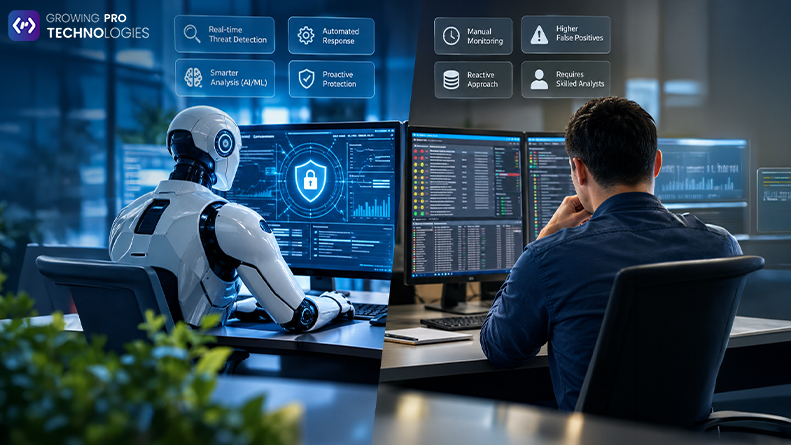
An AI security agent makes threat evaluation and carries out other tasks related to security using AI models, security data, and tools defined by you. It may collect data, correlate alerts, provide information about incidents, recommend remediation or take suggested actions depending on configuration.
In case there is anything suspicious about login attempts to the account, think about reporting this issue. An AI agent may evaluate historical data about account logins, changes in permissions to the account and many other parameters and recommend corresponding measures of containment to an analyst.
In addition, some AI agents have capabilities of threat hunting, including creation of queries and their analysis to uncover patterns for further investigation. These tools are extremely helpful for businesses working with threat detection services as they are great for automation of repetitive investigation work.
Why Businesses Need Both Technologies?
1. Improve Detection and Investigation
SIEM platforms provide the underlying telemetry and detection. AI agents assist in interpreting events and investigating insider threats. Together, they enable faster analysis without eliminating the need for evidence-based decisions.
2. Strengthen Incident Response
Security teams can query SIEM alerts to trigger responses through predefined workflows. AI agents can aid in initial evaluation, containment, and/or authorized actions. There should be appropriate approval controls for high-impact steps, such as deactivating critical accounts.
3. Support Compliance and Audit Readiness
To support compliance and audit readiness, organizations need reliable logs, documented incidents, access records, and evidence of security controls. Managed compliance services can help ensure compliance, and integrated monitoring can support investigations and audit preparation.
Security Considerations Before Adopting AI Agents
Using AI agents also involves risks. Permission scopes can be poorly defined, limited, or incorrectly suggested, creating new security gaps. Inputs could be manipulated, and logging may be limited or not done at all.
These controls should be assessed before being deployed to the business:
- Principle of Least privilege: Do not allow agents to access all the data and actions; only allow relevant data and actions for their role.
- Human permission: Ask permission for sensitive/disruptive actions.
- Auditability: Log agent activity, decisions, calls to agents, and responses.
- Testing: Check suggestions for attacks against realistic attacks and see how many of the predictions are wrong.
- Data security: Ensure that others cannot access sensitive areas of use, passcodes, or customer data.
Reliable integrations and ownership are essential. As an experienced SOC service provider, you can help monitor, investigate, escalate, and respond to interconnected systems. Secure cloud solutions effectively extend monitoring to cloud workloads, identities, and applications without creating unintended monitoring gaps.
Conclusion
Security agents that are artificial intelligence based and SIEM systems complement each other. While SIEM provides visibility and detection, AI agents assist in conducting investigations and executing specific tasks. Both are necessary for companies that face emerging threats.
Investing in threat detection services alongside managed compliance services helps organizations improve monitoring, document security activity, and strengthen incident readiness. Growing Pro Technologies supports businesses with managed IT security, continuous monitoring, incident response, and compliance-focused security support. Connect with Growing Pro Technologies to evaluate your current security operations and identify practical opportunities to improve cyber resilience.
Frequently Asked Questions
1. Are AI security agents replacing conventional SIEM solutions?
No. The role of SIEM systems is pertinent in terms of logging, correlation of incidents, and detection. AI agents assist with that and enable investigation, analysis, and response actions.
2. Can AI security agents react to the cyber threats autonomously?
Yes, but only when they are allowed and authorized by the administrator. Any high-impact autonomous actions must have proper permissions, testing, auditing, and approvals.
3. Do small and midsize businesses require AI security agents?
Not all companies will need the automated agents immediately. The company needs to get proper control over monitoring, inventory, incident response, and access control before more automation is applied.
4. What role do SIEM systems play for regulatory compliance?
SIEM systems contain and correlate security logs, detect suspicious activities, and help with investigations. Companies must make sure about proper policies, retention, access, and compliance.
Interesting Reads:
Moving Beyond Traditional VPNs: Zero-Trust Security for Multi-Branch Businesses
How Continuous Profiling Reveals Hidden Performance Bottlenecks?