


Blog
The Rise of MACH Architecture in Enterprise eCommerce
- 2026-11-03
- Custom eCommerce Web Development
Summary: MACH architecture is reshaping enterprise eCommerce through modular services, API-first integration, cloud-native infrastructure, and headless experiences. Businesses investing in custom e-commerce web development and partnering with a custom web development agency can build flexible platforms that adapt to changing demands. Combined with custom CMS development services and PWA solutions, this approach supports faster innovation, more consistent customer experiences, and greater control over technology investments.
A complex catalog, multiple sales channels, third-party applications, and ever-growing consumer expectations make an enterprise e-commerce platform essential. However, making changes in a monolithic platform is usually complex, as several functionalities depend on one closely connected application. The MACH architecture provides a way to separate commerce capabilities into modules using APIs. Businesses exploring custom e-commerce web development can use this approach to modernize selected systems without replacing every part of their existing technology stack.
Understanding MACH Architecture
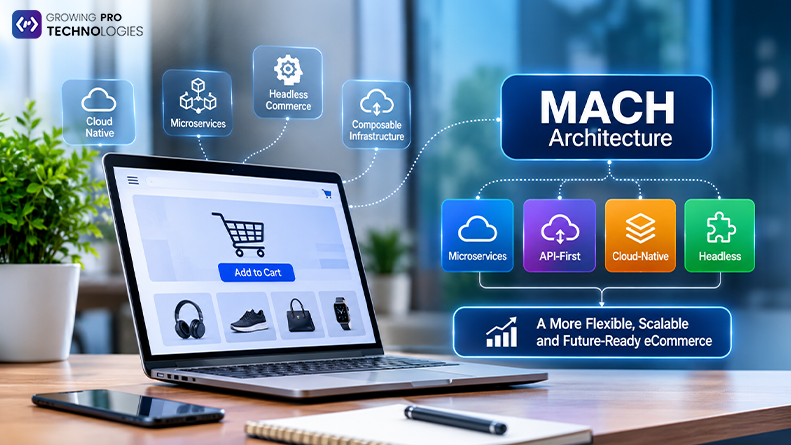
The term MACH can be expanded into Microservices-based, API-first, Cloud-native SaaS, and Headless. The four components describe an architecture that enables enterprises to build and refine their commerce technology according to their requirements.
Microservices
In microservices, the app is broken down into smaller services, with each having specific functionality like inventory, pricing, payments, or organizing orders. Teams can make changes and deploy a single service without having to rebuild the platform, provided they manage the service dependencies effectively.
API-First
API-driven systems provide capabilities through clear-cut application programming interfaces (APIs). They enable storefronts, mobile apps and enterprise resource planning and customer relationship management platforms to share information via standardized contracts.
Cloud-Native SaaS
Cloud-native SaaS software makes use of cloud computing architecture and managed services to deploy and maintain services. The scaling nature and operational aspects will depend on the particular vendor offering that solution.
Headless Commerce
Headless architecture is a method that has a presentation layer (front-end) that is independent from the business-side commerce services (back-end). Developers can develop unique application experiences for websites, mobile devices, and other touchpoints and tie them all together with a commerce service.
Why Enterprise e-Commerce Is Moving Toward MACH?
With markets evolving at a different pace, enterprise retailers are more inclined to adapt to shifting markets without waiting for platform-wide releases. MACH architecture allows teams to enhance the skills of individuals in isolation.
For instance, instead of changing their search service, a retailer can change their payment provider or redesign their storefront while keeping their existing order management procedures. This flexibility means that it will be unlikely that too many system-wide changes will be needed.
Composable principles have been promoted by the MACH Alliance as part of their vision for composable enterprise technology. This strategy is indicative of the change in the industry as a whole moving towards adaptive commerce systems.
Key Business Benefits of MACH Architecture
Greater Flexibility and Faster Innovation
Teams are able to assess new technologies and implement new technologies where they provide value. Independent development and deployment also allows for focused experimentation, as long as testing and releasing back and forth works well.
Scalability Across Commerce Operations
A company could have sudden demand for product searches or checkout during a large campaign. An architecture properly designed will allow one to scale a service pertinent to the application independently without having to scale all the application components. This will depend on the service that it is a part of, infrastructure constraints, and workload architecture.
More Consistent Omnichannel Experiences
A unified array of commerce APIs can power websites, mobile apps, in-store systems, and more. The advantage is that businesses can keep product info, price rules, and customer handling consistent across channels.
Reduced Dependence on a Single Vendor
Businesses can choose cloud providers for various capabilities. This doesn't mean vendors aren't still needed, as their APIs, data structures, and contracts can create further challenges when migrating to another system.
Building a MACH-Based e-Commerce Ecosystem
To be successful, the boundaries of business capability and the actual plan for integration should be clearly written. Organizations need to determine which services need to scale up or down independently, which services have other functions they must perform or update regularly, and which services need to be built to provide one or more functions not available elsewhere. From there, they can choose the right platforms and specify data exchange, failure handling, and transaction integrity.
API integration and enterprise architecture expertise is a specialty of a custom web development agency that can help design these connections and implement appropriate testing, monitoring, and security measures. Before interconnecting multiple systems, it is also crucial for teams to establish a sense of ownership for their customer data, product catalogs and product pricing, as well as inventory and product orders.
Conclusion
MACH architecture gives enterprise eCommerce businesses a structured way to build flexible, connected, and adaptable commerce platforms. Its benefits depend on thoughtful service boundaries, dependable APIs, strong governance, and realistic operational planning. Organizations that invest in custom e-commerce web development and work with an experienced custom web development agency can evaluate this approach against their long-term technology goals.
Review your current commerce architecture, identify its biggest constraints, and develop a practical modernization roadmap with your technology team. Partner with Growing Pro Technologies to build a scalable, future-ready eCommerce platform powered by modern MACH architecture.
Frequently Asked Questions
1. What is MACH architecture in eCommerce?
Microservices, API-first design, cloud-native SaaS, and headless presentation are the key elements of the MACH architecture. It enables businesses to seamlessly integrate stand-alone e-commerce functionalities into a unified tech environment.
2. How does MACH architecture differ from monolithic eCommerce?
A monolithic platform usually integrates a collection of features into a tightly coupled application. MACH divides functionality into modular services and further disconnects the front end, enabling teams to update selected functionality pieces individually. Even in the case of businesses that have more straightforward requirements, a designed platform such as the monolithic platform can be a good fit for them.
3. Is MACH architecture suitable for every enterprise?
Not necessarily. It is commonly used in companies that have a need for a freer flow of integration, possess various channels for customers to visit, must release schemas and products regularly, or have particular commerce requirements. For those that have a simpler operation with their business, dealing with a unified platform might be easier and a less expensive process.
4. Does MACH architecture improve eCommerce performance?
It enables one to scale specific services and optimize getting stores in the field separately. Successful performance relies on infrastructure, API latency, caching, database design, and service dependency management, in conjunction with performance, i.e., the teams involved.
Interesting Reads:
Moving Beyond Traditional VPNs: Zero-Trust Security for Multi-Branch Businesses
AI Security Agents vs. Traditional SIEM Tools: What Businesses Need to Know