



Blog
What Is CVSS Scoring and How Does It Help Prioritize Vulnerabilities for Remediation?
- 2026-11-05
- vulnerability scanning services
Summary: CVSS scoring is an excellent tool for prioritization of remediation of security weaknesses. By considering exploitability, potential impact, and environment, security teams can decide which weaknesses to address first. CVSS scoring is helpful in vulnerability assessments and penetration testing.
As a result of your last vulnerability assessment, you identified approx. fifty security weaknesses. Which ones should your IT team fix first? You may not be able to address all vulnerabilities at once; however, ignoring one could lead to the disclosure of sensitive business data. To address this, the Common Vulnerability Scoring System (CVSS) can be very helpful. It will allow you to prioritize and assess the severity of vulnerabilities.
1. What Is CVSS?
The Common Vulnerability Scoring System (CVSS) is an open framework developed and maintained by FIRST (Forum of Incident Response and Security Teams). It allows assigning numerical scores to software, hardware, and firmware vulnerabilities according to their technical characteristics.
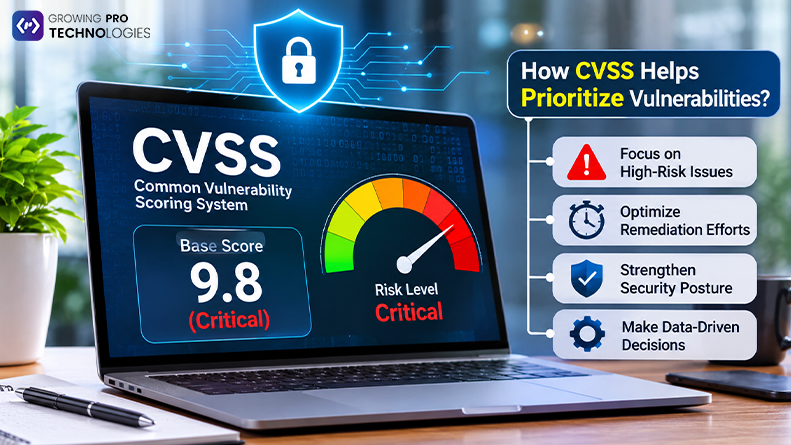
CVSS scores can vary from 0.0 to 10.0 with higher scores representing higher vulnerabilities' severity. CVSS framework helps security experts to compare different vulnerabilities and define a common approach for vulnerability assessment.
There are four groups of metrics used in CVSS v4.0 framework:
- Base Metrics – assessing the technical characteristics and potential impacts of the vulnerability.
- Threat Metrics – taking into account such parameters as vulnerability exploitability and presence of the vulnerability being exploited.
- Environmental Metrics – taking into account organization infrastructure, security controls, and importance of the assets.
- Supplemental Metrics – providing additional data for decision making purposes.
2. Understanding CVSS Severity Levels
CVSS scoring allows security teams to categorize vulnerabilities according to their severity.
|
CVSS Score |
Severity |
|
0.0 |
None |
|
0.1–3.9 |
Low |
|
4.0–6.9 |
Medium |
|
7.0–8.9 |
High |
|
9.0–10.0 |
Critical |
For instance, a vulnerability with a score of 9.5 will definitely require immediate attention due to the potential impact and exploitations of the vulnerability. On the other hand, less severe vulnerabilities may be remediated depending on the exploitability and importance to the business.
However, the severity level will serve as a basis for investigations and does not imply the deadline for vulnerability remediation.
3. How CVSS Helps in Prioritization of Fixing?
A vulnerability report may include dozens or even hundreds of findings. CVSS helps security teams to organize these findings and define where the remediation efforts will be started.
There are three aspects that should be considered:
Exploitability – vulnerabilities that can be exploited remotely or with low privileges will require faster attention.
Potential impact – weaknesses that can potentially expose confidential information, compromise the integrity of the system, or disrupt critical business operations deserve more attention.
Importance for business – a vulnerability affecting a business-critical application will require more attention than an identical vulnerability affecting some isolated test system.
Taking all of these aspects into consideration helps organizations to build a more pragmatic schedule of remediation instead of equal treatment of all findings.
4. Business Importance
A high CVSS score does not always mean that the vulnerability is posing an immediate risk to the organization.
Let us consider two vulnerabilities with the same score. The first vulnerability affects a critical application that serves customers. The second vulnerability affects an isolated internal testing system. Business importance and exploitability of these vulnerabilities may vary significantly.
That is why the security team should consider asset importance, existing safeguards, network exposures and threat intelligence.
Organizations engaged in endpoint cybersecurity should analyze whether the vulnerable device provides access to sensitive applications or connected business systems. The same is true for organizations working with experienced cloud security providers.
5. CVSS and Vulnerability Assessments
CVSS scoring becomes very helpful when it is used in vulnerability assessments and penetration testing.
Typically, the vulnerability assessment process involves several stages:
- Vulnerability discovery – network scanning and discovery of the potential weaknesses in the networks, applications, and infrastructure.
- Finding evaluation – analysis of vulnerabilities and understanding of their technical characteristics.
- Severity assignment – assignment of a severity score using the CVSS framework.
- Business risk assessment – consideration of the exploit availability, asset criticality, and existing safeguards.
- Remediation planning – remediation of the identified vulnerabilities and validation of the effectiveness of the measures taken.
Vulnerability scanning services can assist organizations in identifying vulnerabilities and building a more holistic understanding of their security posture. A network security agency can help in the assessment of exposed systems and network-level risks.
Conclusion
CVSS scoring helps businesses to transition from long vulnerability reports to prioritization and remediation. However, effective prioritization requires more than just severity scores. Organizations should take into account threat intelligence, asset criticality, and vulnerability assessments to understand which weaknesses require attention. GrowingPro Technologies provides vulnerability assessment and penetration testing services.
FAQs
1. What does CVSS stand for in cybersecurity?
CVSS stands for Common Vulnerability Scoring System. It is an open framework for evaluation of severity of security vulnerabilities.
2. What is the highest possible CVSS score?
The highest CVSS score is 10.0 and belongs to critical severity category.
3. Does a high CVSS score always mean immediate remediation?
Not always. Organizations should also take into consideration such criteria as active exploitation, system exposure, asset criticality, and business importance.
4. How often should businesses conduct vulnerability assessments?
Businesses should conduct vulnerability assessments regularly and whenever changes in infrastructure occur, new vulnerabilities arise or some new security threats appear. Requirements of regulatory bodies may affect assessment frequency.
5. How do vulnerability scanning services help with CVSS scoring?
Vulnerability scanning services help to identify potential security weaknesses, to generate assessment findings and to prioritize remediation according to CVSS scoring.
Interesting Reads:
Designing Enterprise Finance Applications with Automated Approval Workflows and Audit Trails